The ability to sound like you
Good copy isn’t about having one recognisable writing style.
It’s about understanding who you’re speaking to, what they need to hear, and how the words should make them feel — then adapting the writing without losing clarity, personality, or purpose.
After almost a decade of writing across marine, technology, social care, lifestyle, finance, and other sectors, I’ve worked with established brand voices, helped shape new ones, and written for audiences ranging from first-time sailors to investors, patients, industry experts, and people simply looking for something interesting to read.
Sometimes the right voice is playful and flamboyant. Sometimes it’s authoritative and considered. Sometimes it needs to be warm, patient, and reassuring. And sometimes the most important voice in the piece isn’t mine at all.
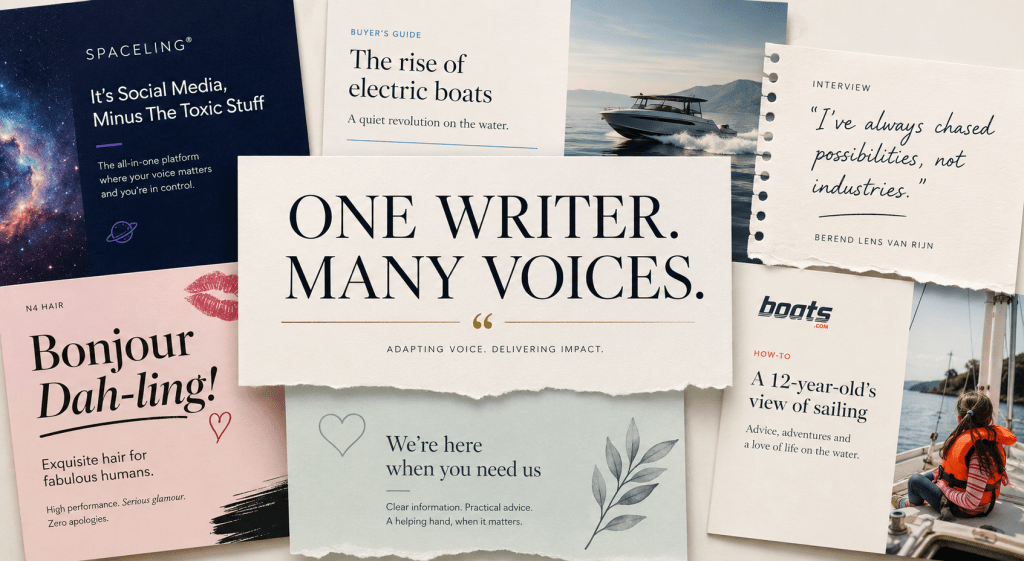
Five ways I flex a voice
SPACELING: Building a flexible brand voice
Developing and applying a distinctive voice across a growing brand — from thought leadership and website copy to user communications, team profiles, and more.
YachtWorld vs. boats.com: One parent company, two distinct audiences
Writing for two established marine brands with overlapping subject matter but different audiences, expectations, and positioning.
Number 4 Hair: Mastering a distinctive brand voice
Stepping into an established, highly distinctive personality — then translating that understanding into guidance another writer could use.
Medical & social care: Writing with a lighter touch
Adapting pace, language, structure, and emotional register when readers may be worried, vulnerable, or making important decisions.
Interviews: Preserving the voice behind the story
Turning conversations into compelling editorial while preserving the personality, expertise, and perspective of the person being interviewed.
The common thread
These projects look very different on the surface.
The underlying skill is the same: editorial judgement.
Knowing when to push a personality and when to pull it back. Knowing how much information a reader needs. Knowing when a brand should sound authoritative, when it should sound human, and when the writer should almost disappear entirely.
Because the best voice isn’t necessarily the one you write in most naturally.
It’s the one that makes the work feel right.
Explore the work & case studies:
SPACELING →
YachtWorld vs. boats.com →
Number 4 Hair →
Medical & social care →
Interviews →